Every Alco Table. Zero Page-Flipping. Easy Everywhere.
AlcoTables turns all 20 alcoholometric tables into a fast calculator: move the sliders, read the exact value immediately. It follows OIML R 22 to the digit, works offline, and runs on your phone, tablet and desktop alike.
Mass · p
Temperature · t
Density · ρ
Volume · q
The AlcoTables Table I density calculator and the OIML table index shown on two phones
Fast to reach
Pick the table, enter the measurements you already have, and read the result without leafing through a printed volume.
Offline by design
The tables stay available when a cellar, lab, or production area has no dependable connection.
Shows its working
Table, formula, inputs, and reference temperature stay on screen together, so no number arrives unexplained.
Complete OIML set
All 20 tables—Table I through Table XIIb—sit in one consistent index that is quick to scan.
Find the table by the measurement in hand.
Use the arrow keys to move through the table index. Home selects the first table and End selects the last.
Table I
Density as a function of temperature and alcoholic strength by mass.
ρ = ρ(p, t)
Use caseWhen a sample’s temperature and mass strength are known, find the density to use in process or laboratory calculations.
Table II
Density as a function of temperature and alcoholic strength by volume.
ρ = ρ(q, t)
Use caseWhen temperature and volume strength are known, find the corresponding density for the sample.
Table IIIa
Density at 20 °C as a function of alcoholic strength by mass.
ρ20°C = ρ20°C(p)
Use caseStandardize a known mass strength to its corresponding density at the 20 °C reference temperature.
Table IIIb
Alcoholic strength by volume as a function of alcoholic strength by mass.
q = q(p)
Use caseConvert a known alcoholic strength by mass into alcoholic strength by volume.
Table IVa
Density at 20 °C as a function of alcoholic strength by volume.
ρ20°C = ρ20°C(q)
Use caseFind the density at 20 °C from a known alcoholic strength by volume.
Table IVb
Alcoholic strength by mass as a function of alcoholic strength by volume.
p = p(q)
Use caseConvert a known alcoholic strength by volume into alcoholic strength by mass.
Table Va
Alcoholic strength by mass as a function of density at 20 °C.
p = p(ρ20°C)
Use caseRecover alcoholic strength by mass from a density measurement standardized to 20 °C.
Table Vb
Alcoholic strength by volume as a function of density at 20 °C.
q = q(ρ20°C)
Use caseRecover alcoholic strength by volume from a density measurement standardized to 20 °C.
Table VI
Alcoholic strength by mass as a function of density and temperature.
p = p(ρ, t)
Use caseUse an observed density and sample temperature to determine alcoholic strength by mass.
Table VII
Alcoholic strength by volume at 20 °C as a function of density and temperature.
q20°C = q20°C(ρ, t)
Use caseUse observed density and temperature to determine alcoholic strength by volume at the 20 °C reference temperature.
Table VIIIa
Corrected alcoholic strength by mass from a soda-lime glass alcoholmeter.
p = p(p′, t)
Use caseCorrect a mass-scale soda-lime glass alcoholmeter reading for the sample temperature.
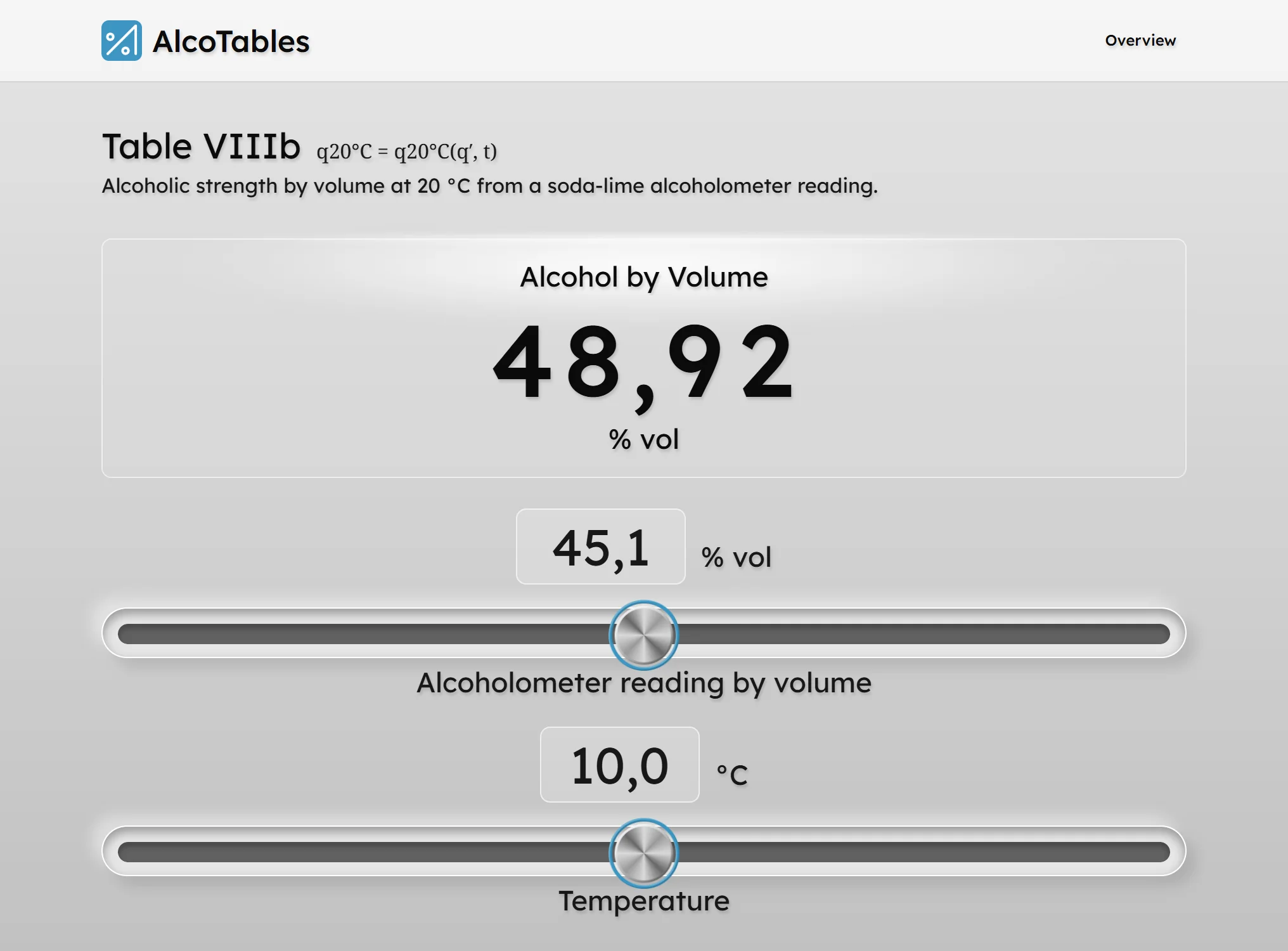
Table VIIIb
Corrected alcoholic strength by volume at 20 °C from a soda-lime glass alcoholmeter.
q20°C = q20°C(q′, t)
Use caseCorrect a volume-scale soda-lime glass alcoholmeter reading to the 20 °C reference temperature.
Table IXa
Alcoholic strength by mass from a soda-lime glass hydrometer.
p = p(ρ′20°C, t)
Use caseDetermine mass strength from a soda-lime glass hydrometer reading and the sample temperature.
Table IXb
Alcoholic strength by volume at 20 °C from a soda-lime glass hydrometer.
q20°C = q20°C(ρ′20°C, t)
Use caseDetermine volume strength at 20 °C from a soda-lime glass hydrometer reading and sample temperature.
Table Xa
Alcoholic strength by mass from a borosilicate glass instrument.
p = p(ρ′20°C, t)
Use caseDetermine mass strength from a borosilicate glass instrument reading and the sample temperature.
Table Xb
Alcoholic strength by volume at 20 °C from a borosilicate glass instrument.
q20°C = q20°C(ρ′20°C, t)
Use caseDetermine volume strength at 20 °C from a borosilicate glass instrument reading and sample temperature.
Table XIa
Volume of pure ethanol at 20 °C in 100 dm³ of mixture.
VAP20°C = VAP20°C(p, t)
Use caseFind the pure-ethanol volume at 20 °C in a 100 dm³ batch from mass strength and temperature.
Table XIb
Volume of pure ethanol at 20 °C in 100 dm³ of mixture.
VAP20°C = VAP20°C(q, t)
Use caseFind the pure-ethanol volume at 20 °C in a 100 dm³ batch from volume strength and temperature.
Table XIIa
Volume of pure ethanol at 20 °C in 100 kg of mixture.
VAP20°C = VAP20°C(p, t)
Use caseFind the pure-ethanol volume at 20 °C in a 100 kg batch from mass strength and temperature.
Table XIIb
Volume of pure ethanol at 20 °C in 100 kg of mixture.
VAP20°C = VAP20°C(q, t)
Use caseFind the pure-ethanol volume at 20 °C in a 100 kg batch from volume strength and temperature.
DiluteBlend
Dilute and blend without the guesswork.
Set the strength you have and the strength you want, and AlcoTables returns the water to add in litres and in kilograms, the volume you end up with, and the sugar for a liqueur. The volume contraction of an alcohol-water mixture is already in the numbers.
Dilute: water to add for a target strength, by volume or by weight.
Blend: the strength and volume you get from mixing two spirits.
Sugar: dissolved sucrose included, so liqueur volumes still add up.
The tables keep working when the network does not.
AlcoTables keeps alcoholometric calculations one tap away on the devices already in your workflow. Table names, formulas, and units stay identical from one screen to the next.
Complete: all 20 OIML tables stay together in one index.
Consistent: table names, formulas, and units never shift on you.
Offline: no connection needed, in the cellar or in the lab.
Accessible anywhere. On any device.
Open the AlcoTables web version wherever the work takes you. All 20 alcoholometric tables stay one click away on desktop, tablet, and mobile.
Keep every alcohol table within reach.
Go from picking a table to a finished calculation without carrying a binder between bench, floor, and desk. Fast, offline, and exact wherever the work happens.